.png)
Fintechs Worried as New Customer Consent Flow Raises Cost and Friction

Introduction
India’s fintech ecosystem is facing another regulatory shift.
A new customer consent framework for accessing mutual fund portfolios is being rolled out.
While aimed at improving data security, fintechs fear higher costs and user friction.
The change could reshape how portfolio aggregation and advisory platforms operate.
Also read :
What Has Changed in the Consent Process
The consent mechanism for accessing mutual fund data has been tightened.
Key changes include:
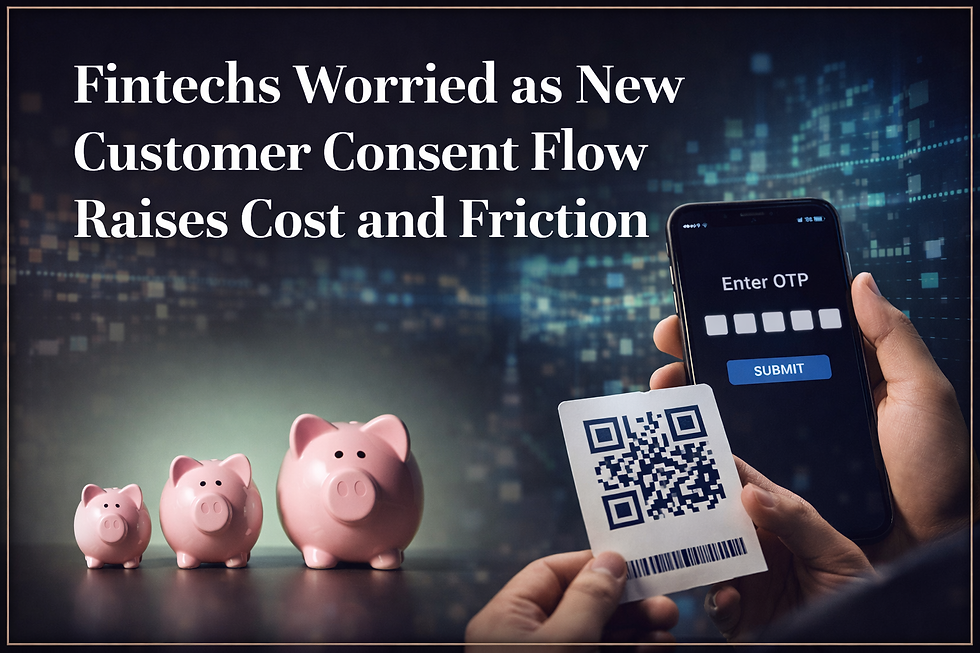
Mandatory OTP-based authentication
QR code upload for verification
Replacement of earlier one-time consent
What was once seamless is now more procedural.
Why Regulators Are Pushing This
The move is rooted in data protection and investor safety.
Regulatory intent focuses on:
Preventing misuse of investor data
Ensuring explicit and informed consent
Strengthening audit trails for access
The emphasis is control, not convenience.
Interested read:
Impact on Fintech Platforms
Fintechs that rely on portfolio visibility face immediate challenges.
Concerns include:
Higher drop-offs during onboarding
Increased operational and compliance costs
Reduced user engagement due to friction
Scale-driven fintech models may see pressure.
Worth checking:
Investor Experience Takes a Hit
Retail investors may feel the impact directly.
Possible outcomes:
Longer onboarding journeys
Repeated consent prompts
Confusion around verification steps
Convenience, a key fintech advantage, is diluted.
Role of Market Infrastructure
The framework affects multiple layers of the ecosystem.
Key stakeholders involved:
RTAs and mutual fund registries
Fintech aggregators and advisors
Asset Management Companies
Coordination gaps could worsen user experience.
Connect on LinkedIn:
Regulatory Balance: Safety vs Innovation
The broader debate remains unresolved.
Key questions:
How much friction is acceptable for safety?
Can standardisation reduce repeated consent?
Will innovation slow under compliance load?
This tension will define fintech evolution.
What Fintechs May Do Next
Adaptation is inevitable.
Likely responses include:
UX redesign to simplify consent steps
Higher focus on high-value users
Consolidation among smaller players
Only efficient platforms will sustain scale.
Conclusion
The new consent flow marks a shift toward tighter control over investor data.
While well-intentioned, it introduces friction and cost for fintech platforms.
The long-term outcome will depend on how regulators balance protection with usability.
FAQ
Q1. What is the new consent flow for mutual fund data?
It involves OTP verification and QR code upload instead of one-time consent.
Q2. Why are fintechs concerned about this change?
Because it increases onboarding friction and operational costs.
Q3. Does this affect all investors?
Yes, especially those using portfolio tracking or advisory apps.
Q4. Is this change mandated by regulators?
Yes, as part of stronger data protection and consent norms.
Q5. Will this slow fintech innovation?
It may in the short term, unless processes are streamlined.
Citations
Securities and Exchange Board of India (SEBI)
Association of Mutual Funds in India (AMFI)
Registrar and Transfer Agent (RTA) circulars
Industry Fintech Policy Reports
Investor Protection Frameworks (India)


Comments